















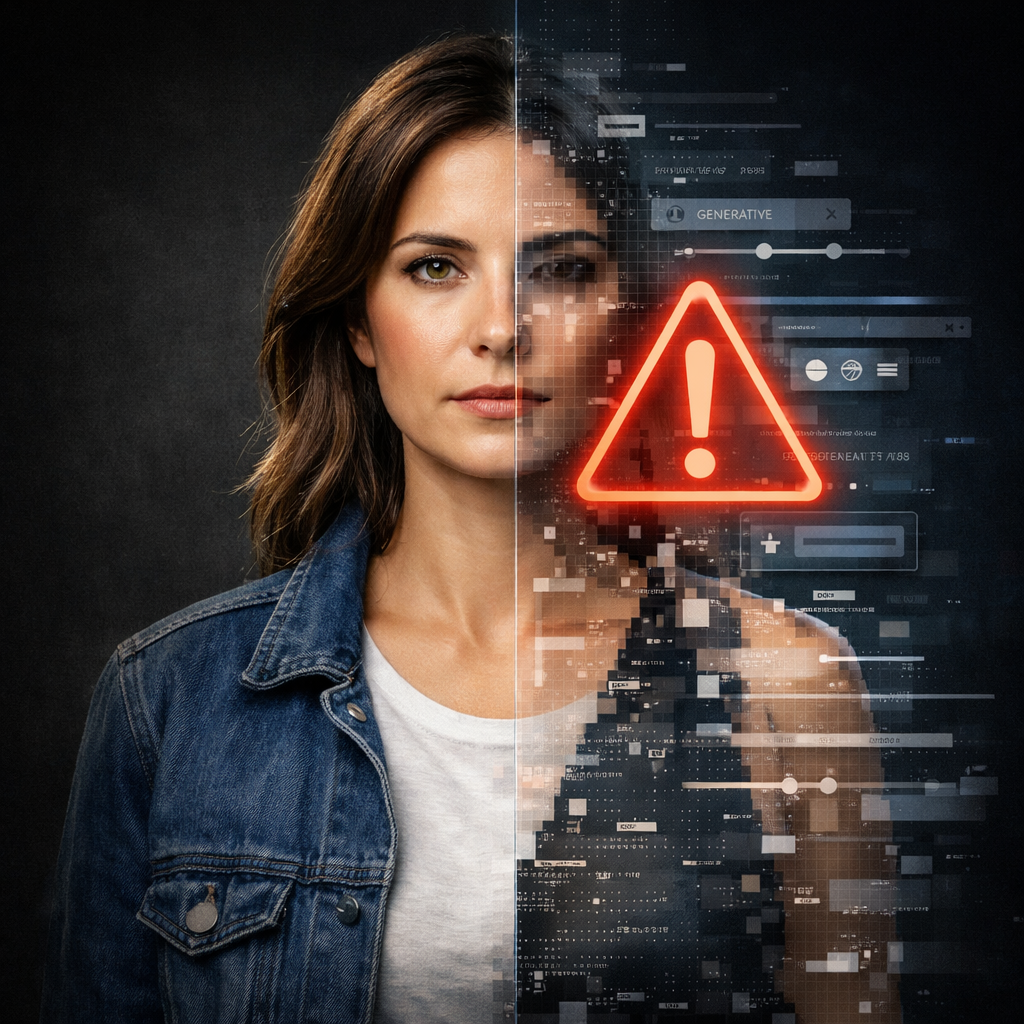
I’m a woman, and I work in marketing. So when I see AI being used to change women’s clothes in photos, I see a behavior men have been getting away with for years, now automated and sanitized by software.
Before AI, this happened in smaller, uglier corners of the internet with screenshots, Photoshop edits, private forums, and deepfake communities. It took effort. It took intent. And when it crossed a line, there were consequences.
Women have sued. Successfully at that.
People have been taken to court for morphing images, altering bodies, and distributing edited photos without consent. The legal system recognized something simple: changing someone’s image without permission is harm.
What’s different with AI is the absence of accountability.
AI didn’t create this impulse. It systematized it. It removed friction, scale limits, and social cost. One prompt can now do what once required skill, time, and risk. And when something harmful becomes effortless, it doesn’t stay rare. It becomes routine.
That’s why the Grok trend matters.
Not because the tech is impressive, but because the framing is reckless. Prompts like “make me wear a bikini” are treated as harmless input, even though the system has no way of knowing whether the image actually belongs to the person asking.
Grok doesn’t verify identity, nor does it verify consent. It doesn’t know whether the photo is of the user, a public figure, an ex, a colleague, or a stranger.
And yet it proceeds anyway.
That’s the failure. The system assumes permission where it cannot possibly exist. And that assumption disproportionately harms women.
This normalization is the real danger. Because altering a real person’s appearance without consent is not a gray area. It’s where ethical AI in image generation stops being theoretical and starts being negligent.
And, this didn’t start with Grok.
Before bikinis, it was sarees. Trends like the Nano Banana AI 3D figurine edits turned women into dolls, collectibles, or stylized objects. Different language, same outcome. Someone else decides how a woman should look.
Culture, morality, and now “art style” have all been used as cover. The behavior hasn’t changed. Only the tools have.
Here’s the part that makes this indefensible.
In marketing and design, you cannot use, edit, or adapt work that isn’t yours without permission. You pay licensing fees, you credit creators, and most importantly, you face legal action if you don’t. No one accepts “the tool let me do it” as an excuse.
Yet AI systems are allowed to bypass that standard entirely when it comes to people’s faces and bodies.
That double standard is staggering.
Consent can never be optional . And many women have been explicit about it. Journalists, creators, public figures, and everyday users have said the same thing: don’t use my image, don’t alter my body. And yet the tools still allow it. Some barely slow it down.
This is not misuse. That’s a design choice.
Which brings this back to responsibility.
If you’re building these systems, you don’t get to hide behind neutrality. Especially not when you run the platform. Elon Musk doesn’t get a pass here. If Grok can undress women without consent, that’s a failure of leadership, not imagination.
And to be blunt: no one wants to see Elon Musk in a bikini either. The difference is power. Women get ostracized, demeaned, and violated. He doesn’t.
Ethical AI in image generation isn’t about what’s technically possible. It’s about what should be refused by default. Until consent is enforced, not suggested, this isn’t innovation.
It’s exploitation with better UX.